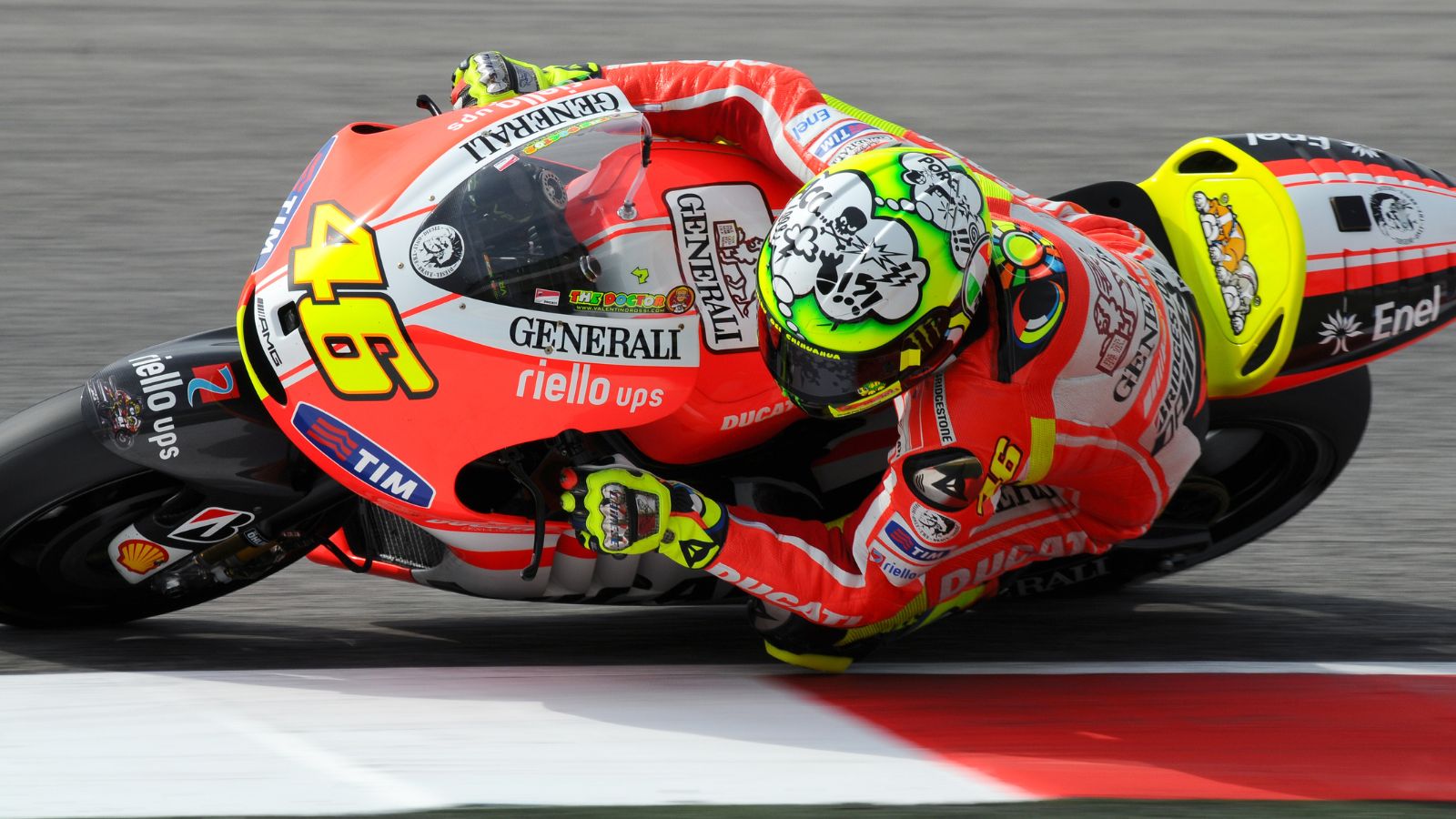
Valentino Rossi is one of the greatest riders in MotoGP history, a nine time world champion who dominated the sport with Yamaha and Honda. But when he left Yamaha at the end of 2010 to join Ducati, many believed it would be a dream partnership a legendary rider teaming up with Italy’s most iconic motorcycle brand. Instead, it became the biggest failure of his career, a two year stint that saw him struggle at the back of the grid, unable to tame Ducati’s unforgiving Desmosedici.
This failure was neatly summarised by Rossi’s custom helmet design at the Italian GP where a comic book style thought bubble is full of expletives and unmentionable words! The World Champion poking fun at his own folly.
The Bike That Wouldn’t Work
The Ducati MotoGP bike Rossi inherited was a fundamentally flawed machine. Unlike Yamaha’s inline four M1, which was known for its smooth handling and precise front end feel, the Ducati Desmosedici was built around a rigid carbon fiber chassis and a 90 degree V4 engine that made it incredibly difficult to ride. The front end lacked feel, making it nearly impossible to push into corners with confidence something Rossi had always relied on to extract speed.
Ducati’s philosophy was different from Yamaha’s. Their focus had always been on sheer power and top speed, with less emphasis on rideability. While their V4 engine produced monstrous horsepower and made the Desmosedici blisteringly fast down the straights, it was nearly impossible to control in the corners. The lack of feedback from the front tire meant Rossi couldn’t brake late and carry the corner speed that had been his trademark for years.
The Carbon Fiber Chassis Gamble
One of the biggest issues Rossi faced was Ducati’s insistence on using a carbon fiber chassis. Unlike the traditional aluminum twin spar frames used by Honda and Yamaha, Ducati’s frame lacked the necessary flex to provide predictable handling. This meant that once the front tire lost grip, there was no warning it just snapped away.
Rossi and his longtime crew chief, Jeremy Burgess, pushed Ducati to switch to an aluminum chassis, but the factory resisted for most of his tenure. They believed their design was superior, despite the results proving otherwise. By the time Ducati finally conceded and moved to an aluminum frame in 2012, it was too late—the damage was done, and Rossi was already negotiating his return to Yamaha.
From Title Contender to Mid Pack Struggles
Before joining Ducati, Rossi was a perennial title contender. During his two years with Ducati in 2011 and 2012, he failed to win a single race. In contrast, his former team, Yamaha, was still competitive, with Jorge Lorenzo continuing to win races and eventually securing another championship.
Rossi’s frustration grew as he found himself battling midfield riders instead of fighting for podiums. It wasn’t just that he couldn’t win—it was that he couldn’t even see the front of the race. Ducati’s unwillingness to change their engineering approach meant Rossi spent more time fighting the bike than racing his rivals.
The Ducati Curse: A Bike That Defeated Champions
Rossi wasn’t the only rider who struggled on the Ducati. Casey Stoner was the only one who had ever truly mastered it, winning the 2007 title by riding around its flaws. After Stoner left, multiple riders including Nicky Hayden, Andrea Dovizioso, and Jorge Lorenzo struggled with the same issues that plagued Rossi.
It wasn’t until Ducati brought in Gigi Dall’Igna in 2014 that the bike truly began to change. Under his leadership, they moved away from the old carbon fiber frame philosophy, completely redesigned the Desmosedici, and transformed it into the dominant machine it is today. Ironically, by that time, Rossi was back with Yamaha, watching Ducati become a powerhouse without him.
Final Thoughts: A Costly Mistake
Valentino Rossi’s move to Ducati will always be remembered as a miscalculation. It took him from the top of MotoGP to two years of frustration and disappointment. While the idea of an all Italian dream team was exciting on paper, the reality was that Ducati’s philosophy didn’t align with Rossi’s strengths.
His return to Yamaha in 2013 proved how much of the problem was the bike, as he immediately became competitive again. Ducati eventually fixed its MotoGP project, but by then, Rossi had moved on. His time with Ducati remains a cautionary tale: even the greatest riders can’t win if the bike doesn’t work.