The Lamborghini V10 has become a defining symbol of modern Lamborghini performance. First introduced in 2003 with the Gallardo, the V10 was a departure from Lamborghini’s traditional reliance on V12 engines. This new 5.0 liter, naturally aspirated V10 was the company’s answer to the changing supercar landscape and the need for a more accessible model that could broaden the brand’s appeal without compromising its fierce identity.
The Gallardo marked Lamborghini’s entry into a new market segment and needed an engine that was smaller, lighter, and more responsive than the legendary V12. The V10 provided the perfect balance of performance and compactness while still delivering the high revving drama Lamborghini was known for. It was a bold step and a necessary one, proving that Lamborghini could evolve without losing its soul.
Design and Engineering Philosophy
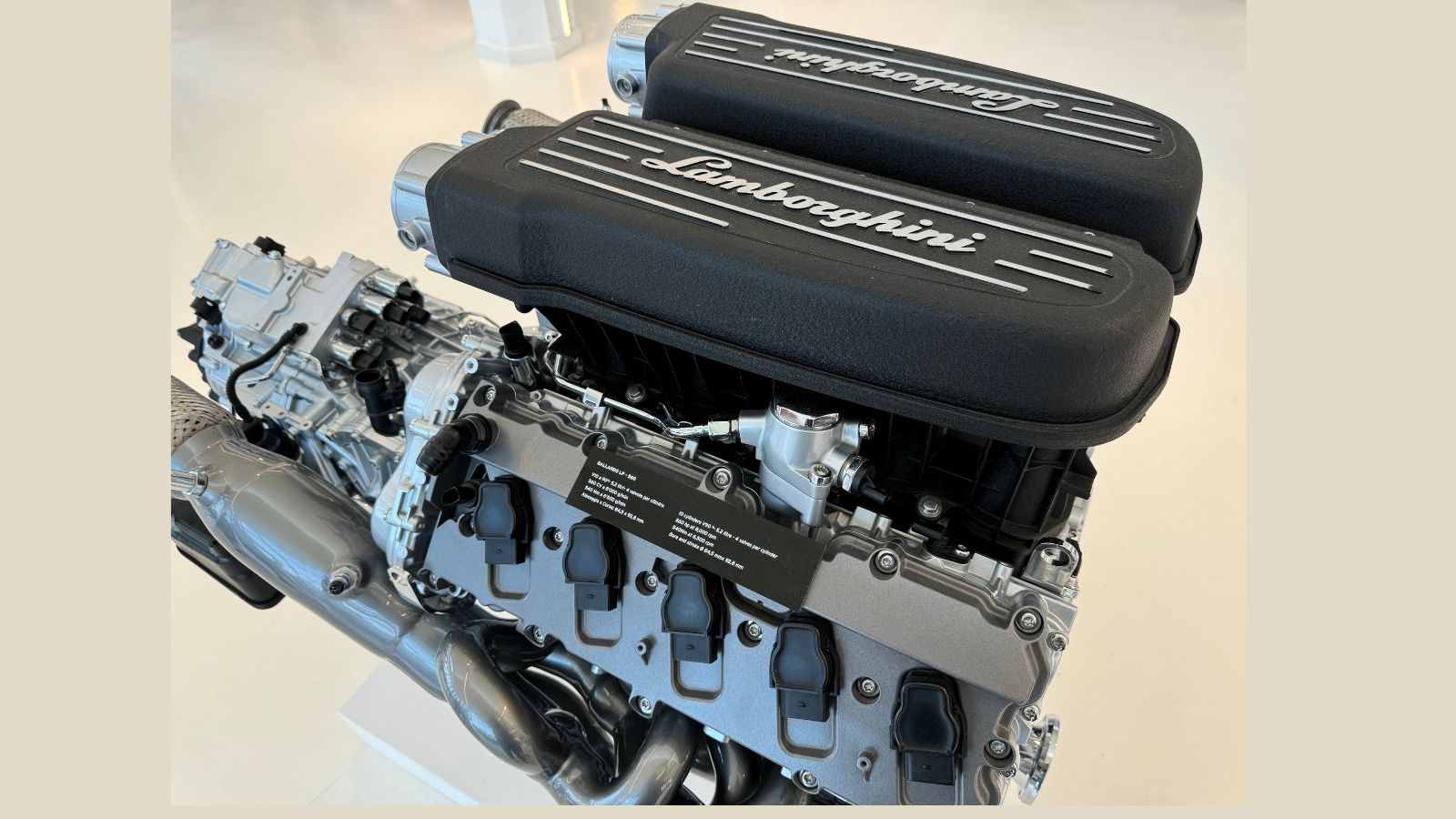
The original 5.0 liter V10 featured dry sump lubrication, dual overhead cams, and variable valve timing. It was designed to be both high revving and tractable, producing around 500 horsepower in early models. The engine sat longitudinally, mounted behind the driver, and was coupled to either a traditional gated manual transmission or a single clutch automated manual gearbox.
With time, the V10 evolved in both displacement and design. The second generation 5.2 liter unit introduced with the Gallardo LP560 4 brought direct injection and a significant boost in performance and efficiency. Power climbed to over 550 horsepower, and responsiveness improved dramatically. The inclusion of direct injection allowed for more precise fuel delivery and greater combustion efficiency, while revisions to intake and exhaust flow enhanced the auditory signature that would become iconic.
In the current Lamborghini Huracán, the V10 continues to serve as the car’s thunderous centerpiece. Producing up to 640 horsepower in the Huracán Performante and STO variants, it remains one of the most exhilarating naturally aspirated engines in the industry. It is celebrated not just for its performance but for its immediacy and emotion qualities often diminished in modern turbocharged engines.
Applications and Versatility
What makes the Lamborghini V10 particularly impressive is its adaptability. It has powered a variety of models, from the all wheel drive Gallardo and Huracán to the lighter, rear wheel drive LP550 2 and Huracán Evo RWD. It has proven equally at home in track focused variants like the Super Trofeo race cars and in limited edition, bespoke models that showcase the brand’s flamboyant character.
Moreover, the V10 was also shared with Audi, appearing in the Audi R8. While tuned slightly differently, the same engine architecture offered a similar thrill, confirming the robustness and versatility of the platform. Despite this shared lineage, Lamborghini tuned its V10s for a more aggressive and visceral experience, with sharper throttle mapping, louder exhaust tuning, and quicker gearshifts in later dual clutch transmissions.
Competition Pedigree and Track Success
The Lamborghini V10 has not only thrilled on the road but also proven itself in motorsport. The engine powers the Huracán Super Trofeo race cars, which form the backbone of Lamborghini’s one-make racing series, Lamborghini Super Trofeo. This championship runs on major circuits around the world, including Europe, North America, Asia, and the Middle East, giving the V10 a global racing presence.
The Huracán GT3 and GT3 Evo, based on the road-going Huracán and powered by the same 5.2 liter V10 engine, have competed in some of the most prestigious endurance and GT racing events globally. These include the 24 Hours of Daytona, the 12 Hours of Sebring, the Blancpain GT Series, and the Nürburgring 24 Hours. Lamborghini’s GT3 program has seen multiple championship titles and race victories, cementing the V10 as a serious contender in the racing world.
Thanks to its durability, linear power delivery, and reliability under endurance conditions, the V10 has become a favorite among customer racing teams. The success of these GT3 and Super Trofeo entries highlights the performance credibility of the engine, showing that it is not just an exotic road car centerpiece but a battle-hardened racing engine as well.
The Emotional Core of Modern Lamborghinis
The V10 is more than a powerplant. It is the sonic and emotional core of every car it touches. The scream of the engine climbing to 8,500 rpm, the crackle on overrun, and the throttle response underfoot deliver an experience that few modern powertrains can match.
In a time when forced induction and hybrid systems are becoming the norm, Lamborghini’s V10 stands defiant. It is a celebration of combustion, of mechanical purity, and of the unfiltered connection between car and driver. It is this connection that has won over purists and made the V10 a vital part of Lamborghini’s modern legacy.
A Legacy in the Making
As Lamborghini transitions toward hybrid and electric models, the naturally aspirated V10 stands as a monument to an era. It has carried the brand through some of its most successful years, introduced Lamborghini to a broader audience, and provided the beating heart for some of the most thrilling cars of the 21st century.
Whether in a first generation Gallardo, a Huracán Evo, or a limited edition STO, the V10 delivers a symphony of performance, passion, and design that is unmistakably Lamborghini. It has earned its place alongside the legendary V12 and will be remembered as one of the great engines in supercar history.