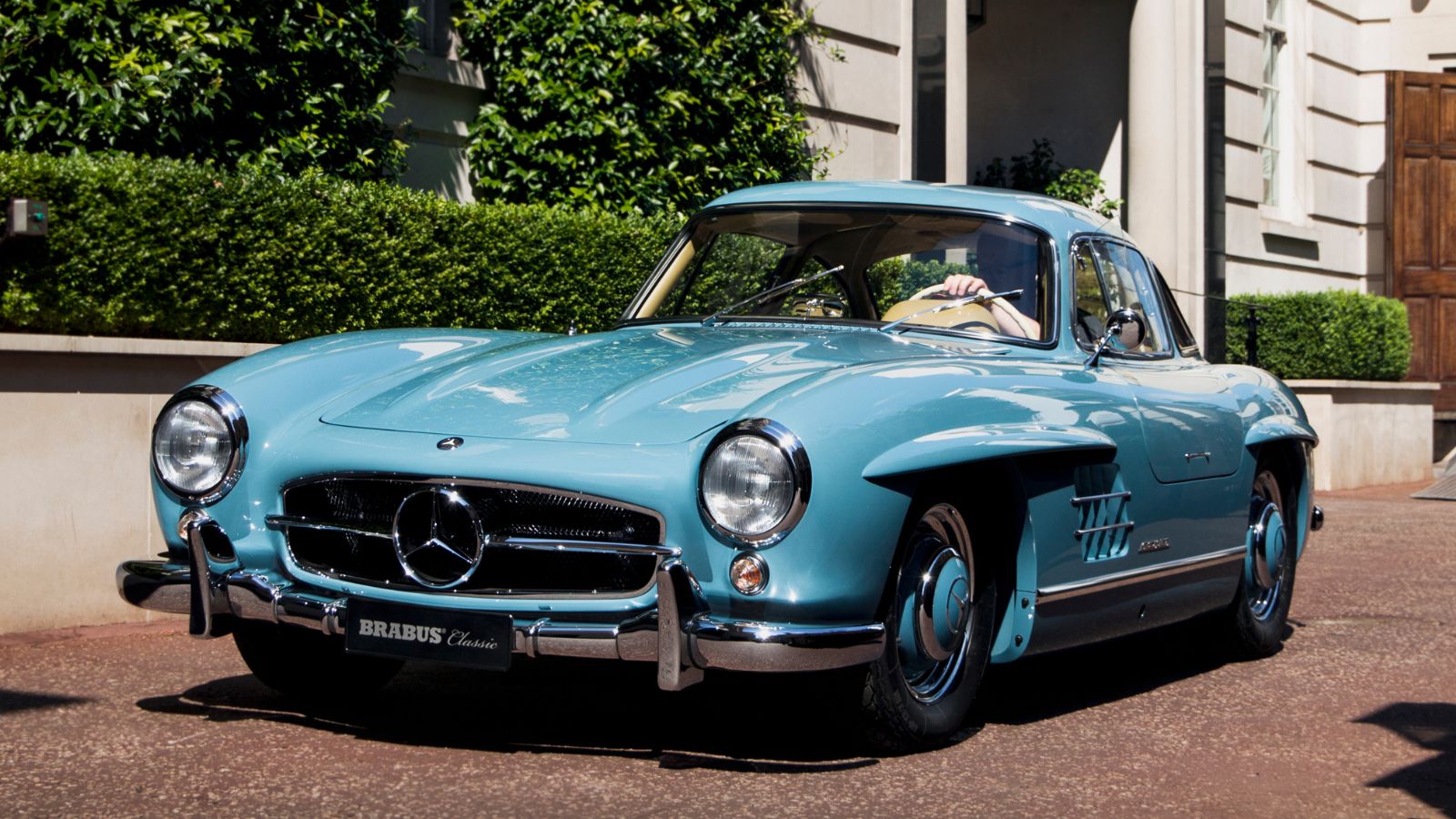
The Mercedes 300SL of 1955 is widely celebrated as the world’s first true road going supercar. With its dramatic gullwing doors, cutting edge engineering, and undeniable racing pedigree, the 300SL didn’t just break ground it rewrote the rules for what a production car could be. Originally conceived as a race car for the 1952 season, the SL short for “Sport Leicht” or Sport Light was soon adapted into a roadgoing version due to public demand and the insistence of American importer Max Hoffman.
A Racing Heart in a Road Car Body
What set the 300SL apart from the outset was not just its speed but the way it integrated cutting edge technology into a form that was both beautiful and functional. The car’s aerodynamic silhouette was the result of wind tunnel testing and race bred experience, lending it a sleek and futuristic look. It was a car that combined visual drama with genuine motorsport ability.
Mechanical Marvel: Specifications and Innovations
Under its long, elegant hood sat a 3.0 liter inline six cylinder engine with Bosch mechanical fuel injection a world first in a production car. This innovation alone gave the 300SL a significant performance edge over its carbureted contemporaries. The engine produced 215 horsepower, enabling the car to reach a top speed of 161 mph, depending on the axle ratio chosen by the buyer.
The 300SL was fitted with a four speed manual gearbox, rear wheel drive, and independent suspension at all four corners. Its tubular spaceframe chassis, designed to save weight and add rigidity, dictated the high door sills and the now iconic gullwing doors. At just 1,295 kilograms 2,855 pounds, it had an excellent power to weight ratio for its time.
Key Specifications:
- Engine: 3.0 liter inline 6, mechanical fuel injection
- Power: 215 horsepower
- Transmission: 4 speed manual
- Top Speed: Up to 161 mph depending on axle ratio
- 0 to 60 mph: Approx. 8.8 seconds
- Chassis: Tubular spaceframe
- Suspension: Independent front and rear
- Brakes: Drum brakes on all four wheels
The use of lightweight alloys in the body panels helped reduce mass, and the car’s compact dimensions gave it agility rarely seen in grand tourers of the time. The combination of advanced aerodynamics, mechanical precision, and durability made the 300SL more than just a fast car it was a statement of intent.
The 300SL in Competition
Though developed from the 1952 W194 race car, the 300SL’s transition to a production road car didn’t mean it abandoned the racing world. The 300SL Coupe and its later Roadster variant were both actively used in motorsport during the mid 1950s. However, its true roots lie in the W194, which had already achieved fame by winning the 1952 24 Hours of Le Mans and the Carrera Panamericana.
One of the most legendary moments in the 300SL’s competitive timeline was Stirling Moss’s win in the 1955 Mille Miglia. Though technically piloting a Mercedes 300 SLR, that car’s development and success stemmed from the engineering roots of the SL program. The DNA of the SL was firmly embedded in that victory, and by extension, the car earned a place in the history books of endurance racing.
The 300SL also saw success in the Tour de France Automobile, the Liege Rome Liege rally, and various hillclimb events. It proved to be not only a high speed cruiser but a versatile competitor in the grueling world of mid century motorsport. Drivers praised its reliability and consistency in long distance events, traits inherited from its racing foundation.
In privateer hands, the 300SL was often modified slightly for better performance, showing just how race capable it remained even in its showroom form. From European circuits to American hillclimbs, the 300SL built a reputation not just as a showstopper but as a formidable contender.
Icon Status and Lasting Legacy
Today, the 1955 Mercedes 300SL is considered an icon of engineering and design. It paved the way for the idea that a production car could deliver both race bred performance and everyday usability something that would become the blueprint for every supercar to follow.
Its gullwing doors became a symbol of exotic automotive design, while its mechanical innovations influenced generations of performance vehicles. With its mix of lightweight construction, high speed capability, and timeless styling, the 300SL remains one of the most collectible and admired vehicles in automotive history.
Ownership today represents not just prestige but a connection to one of the golden eras of motorsport and innovation. Each 300SL is a testament to Mercedes Benz’s relentless pursuit of excellence. Collectors cherish its combination of mechanical purity and expressive design.
Restored models command eye watering sums at auction, and unrestored survivors are treated as rolling pieces of history. Its legacy is not just in museums but on roads and concours lawns around the world. As the original road going supercar, the 300SL didn’t just capture the spirit of its time it defined it, and it continues to inspire every car enthusiast who dreams of driving something truly extraordinary.