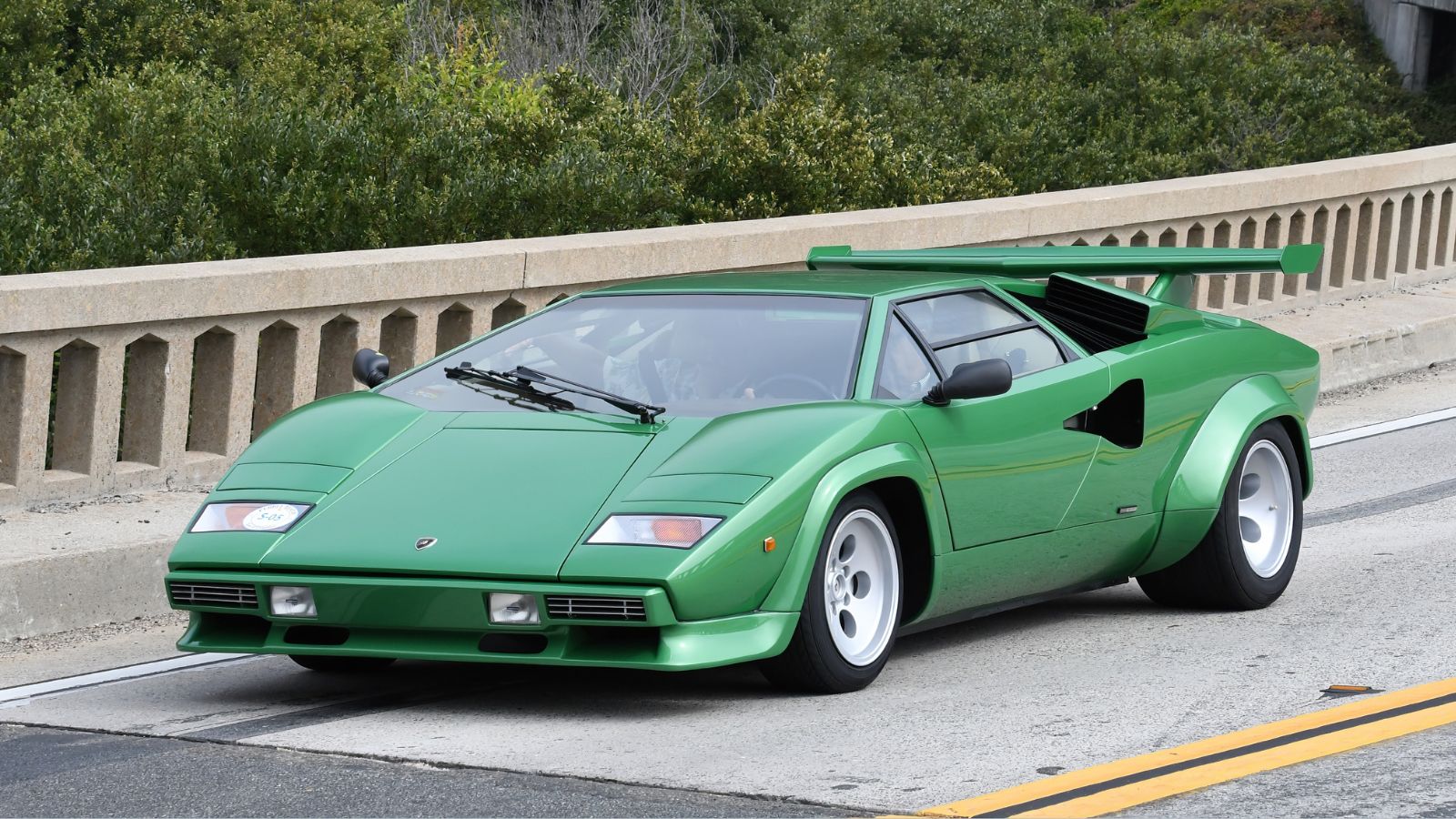
The Lamborghini Countach remains one of the most visually arresting cars ever designed. It was not just a car, it was a poster, a dream, a presence. Designed by Marcello Gandini for Bertone and revealed in prototype form in 1971, the Countach redefined what a supercar could look like. Angular, low, and impossibly wide, it was a rolling spaceship for the road. Yet behind the iconic silhouette lies a car so awkward to operate that it bordered on absurd. And that’s precisely what made it brilliant.
Impractical by Design
The Countach’s styling, while breathtaking, came at the cost of practicality. The car’s shape had the aerodynamic efficiency of a brick, with a drag coefficient of around 0.42. For comparison, even family sedans of the time offered better airflow. But none looked this spectacular. Aerodynamics? Who needs slippery airflow when you’ve got charisma that could warp time and space?
Visibility was another matter altogether. There was essentially no rearward vision. The view out the back was so limited that reversing the car was a practiced skill. Drivers often resorted to sitting on the wide door sill, clutching the open scissor door with one hand and looking backwards while rolling the car in reverse. It looked theatrical, but make no mistake it was necessity turned into style.
Driving the Legend
Inside the Countach, the driving position was uniquely Italian: dramatic, offset, and unforgiving. The pedals were angled like a yoga instructor on espresso, and the steering wheel sat somewhere between your lap and your chest. Tall drivers would contort themselves like circus performers. Side visibility? Optional. The only thing more cramped than the cockpit was the luggage space, which is generous if all you’re carrying is regret and a loaf of bread.
And yet, every drive felt like an event. The Countach was powered by Lamborghini’s thunderous V12 engine, which grew from 3.9 liters to a monstrous 5.2 liters in later versions. Mounted longitudinally and paired to a five speed manual gearbox mounted in front of the engine, the drivetrain layout was a marvel of packaging and mechanical bravado.
Power figures varied depending on the model, but the LP5000 QV delivered around 455 horsepower. That might not sound monumental today, but in a wedge of fiberglass and aluminum with barely any driver aids, it was like strapping yourself to a rocket and lighting the fuse.
The Tail That Did Nothing
Adding to the drama was the optional (and often retrofitted) rear wing. A visual masterstroke and aerodynamic afterthought, the wing added drag and shaved top speed. It did very little in practical terms, but it looked outrageous and that’s all that mattered. If the Countach was a supermodel, the wing was its haute couture feather boa: pointless but perfect.
Pop Culture Royalty
Despite, or perhaps because of, its many flaws, the Countach became the supercar of choice for bedroom walls in the 1980s. The Athena poster featuring a red Countach with a sunset backdrop became a symbol of aspiration and excess. It was a machine that told the world you had arrived or at least that you dreamed big.
It became a movie star in The Cannonball Run, where it made more of an impression than the plot. Even in animated series like the original Transformers, its sharp wedge design inspired robot characters. The Countach wasn’t just a car. It was the main character of your childhood.
Mechanical Mayhem and Genius
The Countach’s V12 was not just powerful it was a living, breathing beast. Fed by six Weber carburetors in earlier models, it roared and snarled like a wild animal, making every gear change feel like an orchestral explosion. Later versions moved to Bosch K Jetronic fuel injection, improving reliability but softening the savage edge just a little.
Cooling this fire breathing monster was a challenge. Radiators were tucked into the flanks behind those dramatic intakes, and fans worked overtime just to keep things from boiling over. The Countach wasn’t built for traffic jams. It was built to make your heart race and your neighbors jealous.
Suspension was double wishbone at all four corners, tuned more for highway heroics than city comfort. The ride was firm, the steering unassisted, and the brakes took a firm foot. But when it all came together, it was magic. On a sweeping road, few experiences matched the drama and theater of hustling a Countach through the gears.
Why It Still Reigns Supreme
The Lamborghini Countach was never a perfect machine. It was loud, hot, cramped, and difficult to drive. But that was never the point. The Countach represented the thrill of the impossible. It was never about rationality or practicality. It was about presence, poster appeal, and the kind of raw automotive charisma that few cars before or since have managed to deliver.
Today, the Countach stands as a monument to excess and ambition, a symbol of how far design and engineering could be pushed when logic took a back seat to passion. It may have been awkward, but it was also undeniably awesome. And that is why it remains one of the most legendary supercars ever built a flawed masterpiece that rewrote the rulebook and defined an era.