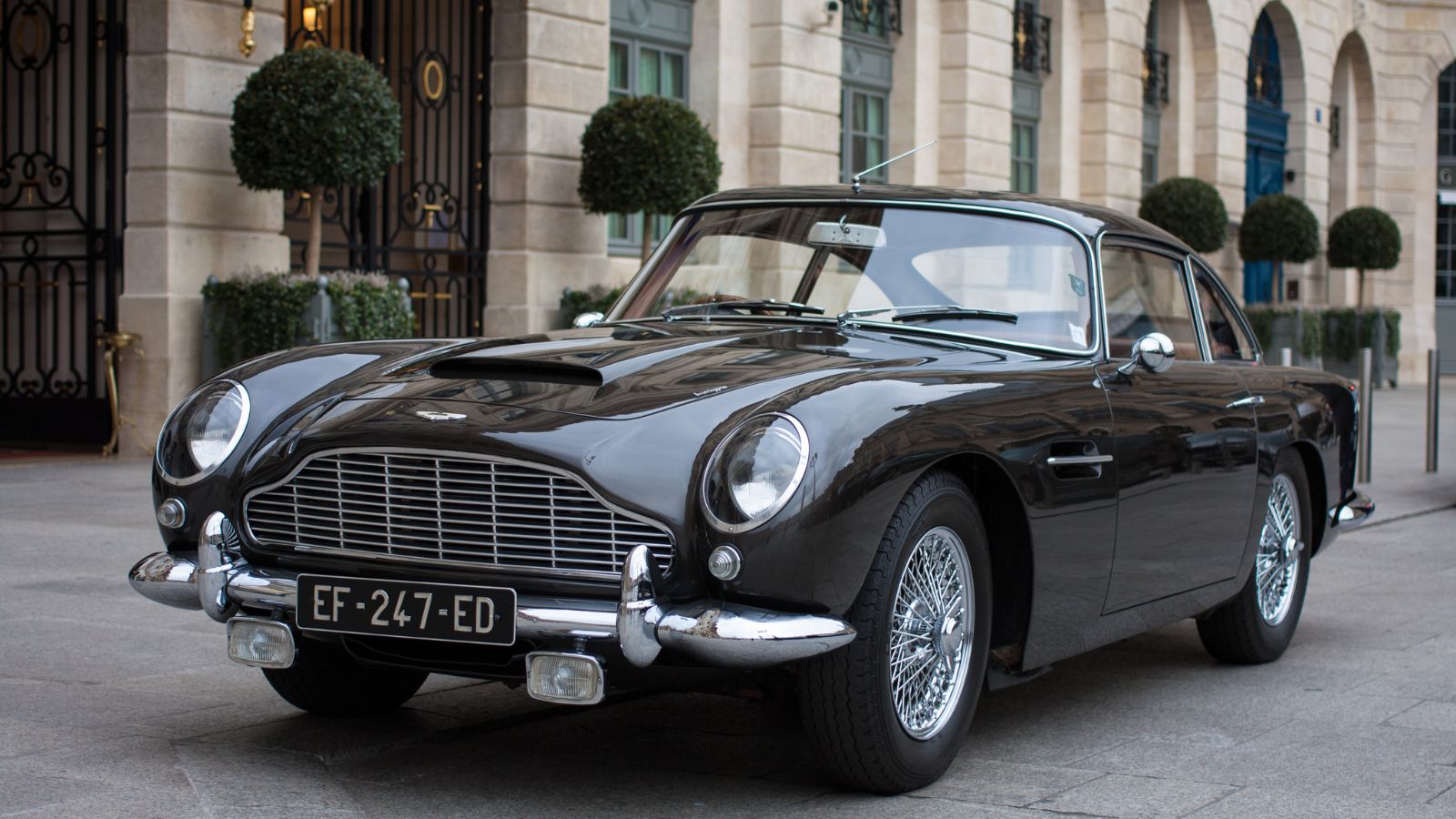
The Aston Martin DB5 is forever linked with sophistication, glamour, and the silver screen. Immortalized by Sean Connery’s James Bond in “Goldfinger,” it became the quintessential British sports car in the public imagination. With elegant lines, luxurious interior, and a host of spy gadgets, it captured hearts around the world.
The Legend of the DB5
But from a driving enthusiast’s standpoint, was it the right car to crown as the symbol of high performance? Beneath the charisma and tailored sheet metal, the DB5 may have looked the part, but compared to its contemporary rival, the Jaguar E-Type, it fell short in nearly every metric of pure performance.
The E-Type: Born on the Racetrack
The Jaguar E-Type launched in 1961 with a roar heard around the world. Derived directly from the racing D-Type and XK lineage that had conquered Le Mans multiple times in the 1950s, the E-Type was no mere road car. It was a competition-honed, high-speed grand tourer built for real drivers.
It brought technology from the racetrack to the road with independent rear suspension, disc brakes on all four wheels, and a monocoque chassis. Enzo Ferrari famously called it “the most beautiful car ever made.” But beauty was only half the story. Under the skin, it was a tour de force of engineering.
Engine Heritage: Twin Sixes, Different Philosophies
Both the Aston Martin DB5 and the Jaguar E-Type were powered by inline six-cylinder engines, but the roots of these powerplants and their development stories are fundamentally different.
Jaguar’s 3.8-liter XK straight six was a direct descendant of the engines that powered the C-Type and D-Type to multiple victories at Le Mans. It featured dual overhead cams, hemispherical combustion chambers, and was tuned for high-revving, high-performance driving. It was race-bred in every sense and delivered not just power, but a snarling, urgent character.
Aston Martin’s 4.0-liter straight six in the DB5 was based on the Tadek Marek-designed engine that had first appeared in the DB4. It was smooth, torquey, and refined, but heavier and more relaxed in its delivery. While powerful, it lacked the motorsport bloodline that made the Jaguar unit so eager and responsive.
Performance Comparison: DB5 vs E-Type
| Specification | Aston Martin DB5 | Jaguar E-Type Series 1 |
|---|---|---|
| Engine | 4.0L Inline-6 | 3.8L Inline-6 |
| Power | 282 hp | 265 hp |
| Weight | Approx. 1465 kg | Approx. 1230 kg |
| 0-60 mph | 8.0 seconds | 6.9 seconds |
| Top Speed | 145 mph | 150 mph |
| Brakes | Front discs, rear drums | Four-wheel disc brakes |
| Suspension | Live rear axle | Independent rear setup |
| Price (1960s) | £4,175 | £2,097 |
Though the DB5 had a slight power advantage, the E-Type’s lighter weight and more advanced suspension delivered a sharper and faster driving experience. It was not just the quicker car, it was also the better handling machine, designed for carving through corners rather than cruising in style.
Suspension and Chassis Architecture: Race Roots vs Road Bias
The E-Type’s suspension setup, especially at the rear, was a game changer. Jaguar used an independent rear suspension design developed under the guidance of Bob Knight, which was revolutionary at the time. It provided superior road holding, comfort, and agility compared to most contemporaries.
In contrast, the DB5 retained a live rear axle, a simpler and older design that did not offer the same level of refinement or control under hard cornering. While suitable for a grand tourer, it fell short in delivering true sports car dynamics.
The chassis designs also followed different philosophies. The E-Type utilized a monocoque structure with a front subframe to carry the engine and suspension, creating a lightweight yet rigid platform. The DB5 used a traditional tubular frame with aluminum body panels, prioritizing luxury and strength over outright agility.
In the Hands of Enthusiasts
Some motoring journalists and seasoned drivers have described the DB5 as “a tractor in a tuxedo.” That may sound harsh, but it points to the fact that, beneath the glamorous finish, the DB5 was not as dynamically capable as its rival. It lacked the finesse and agility of the Jaguar.
The E-Type, on the other hand, remains revered by driving purists. It delivers feedback through the wheel, throttle, and seat in a way few cars ever have. It was a car that lived up to its looks, with performance that thrilled on both road and track.
Racing Pedigree and Street Cred
The DB5’s engine, designed by Tadek Marek, was a development of the 4-liter prototype that raced at Le Mans in 1962 and 1963. This engine and the chassis were indeed designed with performance in mind and were used in the DB5 road car. However, despite its potential and racing-derived components, the DB5 did not translate this engineering into a true competition edge. Jaguar’s E-Type, by comparison, took its cues from machines that had already dominated on the world stage, and its race-bred credentials were apparent not only in engineering but in actual performance on both road and track.
The DB5 was not a racer. It was a gentleman’s express. In contrast, the E-Type was closely related to a genuine Le Mans winner. Jaguar’s racing heritage was deeply embedded in the E-Type’s DNA. It was a car that could be driven to the track, raced competitively, and driven home again.
It’s worth noting that Aston Martin’s last major Le Mans victory before the DB5 came in 1959 with the DBR1, driven by Carroll Shelby and Roy Salvadori. While a monumental achievement, that lineage did not directly influence the DB5’s design in the same way Jaguar’s race cars shaped the E-Type.
Conclusion: The Real Spy’s Choice
There is no denying the DB5’s place in pop culture. It is a style icon, a gentleman’s car, and a fixture in the dream garage of many. But if James Bond had truly needed a machine for high-speed pursuits, technical superiority, and driving pleasure, the Jaguar E-Type was the better choice.
Bond may have had the gadgets, but real drivers knew where the magic was—in the low, sleek, race-bred lines of the E-Type Jaguar. With its combination of racing roots, advanced engineering, and raw driving experience, the E-Type wasn’t just a car. It was an automotive revelation that left even Aston Martin in its shadow. Even David Brown, the man behind Aston Martin and whose initials give the DB models their name, reportedly drove a Jaguar XJ in later years—a subtle but unmistakable stamp of approval for Jaguar’s engineering excellence.