In 1972, Mercedes Benz began an unlikely partnership with Steyr Daimler Puch of Graz, Austria. The goal was not a flashy saloon or a luxury coupe, but a rugged all terrain vehicle that could handle anything from muddy forest trails to deep snow and harsh desert. What they were building was not yet called a G Wagen, but a Geländewagen, literally translated as “terrain vehicle.”
The project was as ambitious as it was utilitarian. Mercedes brought their engineering knowhow and global resources, while Puch brought decades of mountain driving experience and an established manufacturing base in Graz. By 1973, the two companies had signed a formal agreement, and by 1979, the first production version of the G Wagen was ready. Though it launched under the Mercedes badge in most countries, in select European markets including Switzerland and Austria, it was sold as the Puch G, a little known but historically significant detail that still excites collectors and badge hunters today.
Built to Go Anywhere
The original G Wagen was built with serious intent. It featured a ladder frame chassis made from thick steel rails, chosen for its strength and ability to resist twisting forces over rough terrain. The vehicle was fitted with three fully locking differentials, permanent four wheel drive, and solid live axles front and rear. The result was a vehicle that could tackle everything from rock climbs to river crossings without blinking.
Mercedes tested early prototypes in the harshest conditions they could find. From the frozen north of Scandinavia to the burning sands of the Sahara, and even in military trials in coal mines and mountain passes, the G Wagen proved itself again and again. These were not marketing stunts. These were durability missions, and the boxy new vehicle passed every one of them.
Over the years, the G Wagen earned a reputation for being unbreakable. Militaries, police forces, aid organizations, and explorers all adopted it. Even the Pope used a modified version, and rally teams ran it in grueling desert races. Its design remained virtually unchanged for decades, and its simple, square profile became one of the most instantly recognizable shapes on the road.
Mechanical Marvels
The original G Wagen’s engineering was deliberately simple and overbuilt.
- Frame: A heavy duty box section ladder frame provided unmatched torsional strength and durability.
- Suspension: Coil sprung live axles allowed for massive wheel articulation and easy service in the field.
- Differentials: Three mechanical locks allowed the G to maintain traction even if only one wheel had grip.
- Engines: Offered with everything from small diesel fours to smooth inline sixes and V8s, the G held more engine options over its lifetime than nearly any other Mercedes model.
It was the kind of vehicle you could drive up a cliff, hose off, and then use to pick up groceries. That balance of brute strength and civility became the foundation of its enduring popularity.
A Legend That Refused to Die
Most cars get a generational refresh every few years, but the G Wagen soldiered on for decades with minimal changes. That stubbornness became part of its appeal. Mercedes even considered cancelling it multiple times, but customer demand never waned. In fact, it grew stronger. By the 2000s, the G Wagen was being adopted by an entirely new audience—celebrities, athletes, and urban adventurers who loved its presence and attitude just as much as its off road capability.
It went from army truck to red carpet royalty without ever compromising what made it great. That kind of transformation is rare, and it cemented the G Wagen as an icon in automotive history.
Enter AMG: The G Wagon Goes Ballistic
In the early 2000s, Mercedes asked a question that no one had thought to ask: What if we gave the G Wagen serious horsepower? Not just a bigger engine, but a handcrafted AMG V8 with thunder in its cylinders. The result was the first G 55 AMG, and it was as ridiculous as it was brilliant.
Only a handful of V12 powered examples were ever sold, each reserved for world leaders and sheikhs. But the experiment lit a fire under the engineers in Affalterbach, AMG’s home. They realized there was a market for a luxury off roader that could keep up with sports cars.
The 6.3 Liter AMG Era
The G 63 AMG became the flagship of this new approach.
- Engine: The naturally aspirated 6.3 liter M156 V8 produced over 500 horsepower and nearly 470 pound feet of torque.
- Exhaust: Twin side exit pipes delivered a guttural roar unique to the G 63, unlike anything else in the Mercedes lineup.
- Chassis: AMG upgraded the suspension with stiffer springs and thicker stabilizer bars, added larger brakes, and tuned the transmission for aggressive downshifts.
Yet they kept the essentials. The G still had locking differentials, low range gearing, and a ladder frame. It could still crawl up mountains, but now it could also drag race a Porsche to the next overlook.
Sales surged. What was once a niche military derived 4×4 became a mainstream hit. AMG versions outsold standard G Wagens in many countries. In places like Los Angeles, Miami, and Dubai, the AMG G became the ultimate expression of urban status and off road strength.
The 2018 Redesign: All New, Still a G
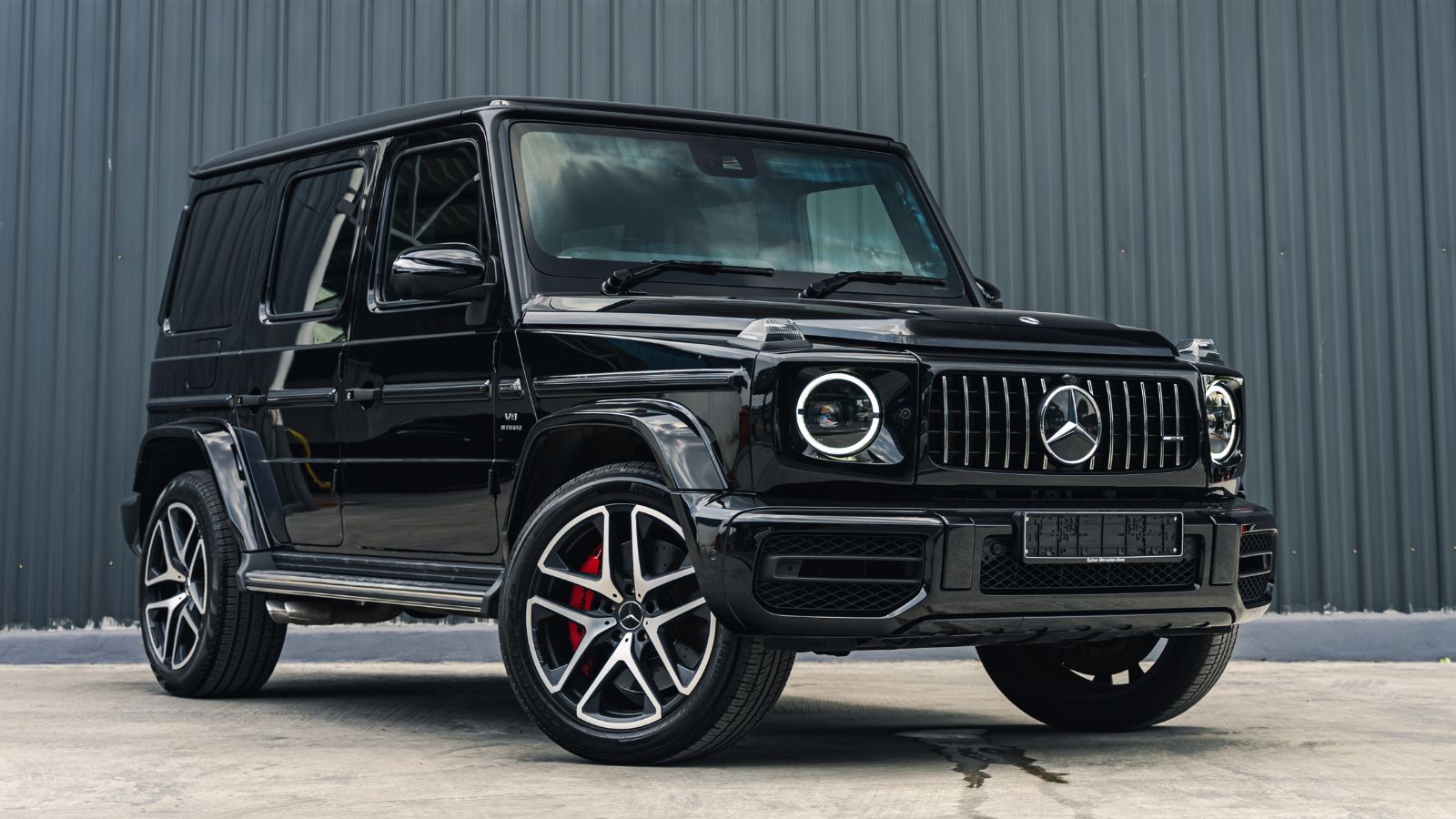
For 2018, Mercedes decided to completely overhaul the G Class for the modern era. But they were smart. They kept the look, the ethos, and the spirit, while improving everything else.
- Chassis: The body now used aluminum extensively, reducing weight by around 160 kilograms while increasing structural rigidity.
- Steering: For the first time ever, the G got rack and pinion steering, finally replacing the old recirculating ball setup and massively improving precision and feedback.
- Suspension: The front end now used independent double wishbones, paired with adaptive dampers and electronic assist. This meant better on road performance without compromising off road ability.
- Interior: Digital displays, modern infotainment, new materials, and more space transformed the cabin into a high tech lounge.
And then there was the engine. The latest G 63 received AMG’s 4.0 liter twin turbo V8. It produced 577 horsepower and 627 pound feet of torque, enough to launch this steel bodied titan to 60 miles per hour in just 4.4 seconds.
Mercedes kept the three locking diffs and off road modes. This was still a G Wagen, but evolved for the twenty first century.
G Wagen Forever
The Mercedes G Wagen is living proof that great design lasts. What started as a tool for soldiers and shepherds has become a global symbol of capability, style, and engineering purity. Its ongoing success is due to its honesty. It never pretended to be something it was not. It is a ladder frame truck that can go anywhere and now happens to look like it belongs on a magazine cover.
The Puch partnership gave it roots in real world terrain. The AMG transformation gave it wings. And the 2018 redesign ensured it would survive into the electric and digital age without losing its mechanical soul.
Very few vehicles stay relevant for nearly fifty years. Even fewer do so by staying true to their original purpose. The G Wagen endures because Mercedes never forgot what made it great. It is squared off, overbuilt, outrageously powerful, and completely unapologetic. Just the way it should be.