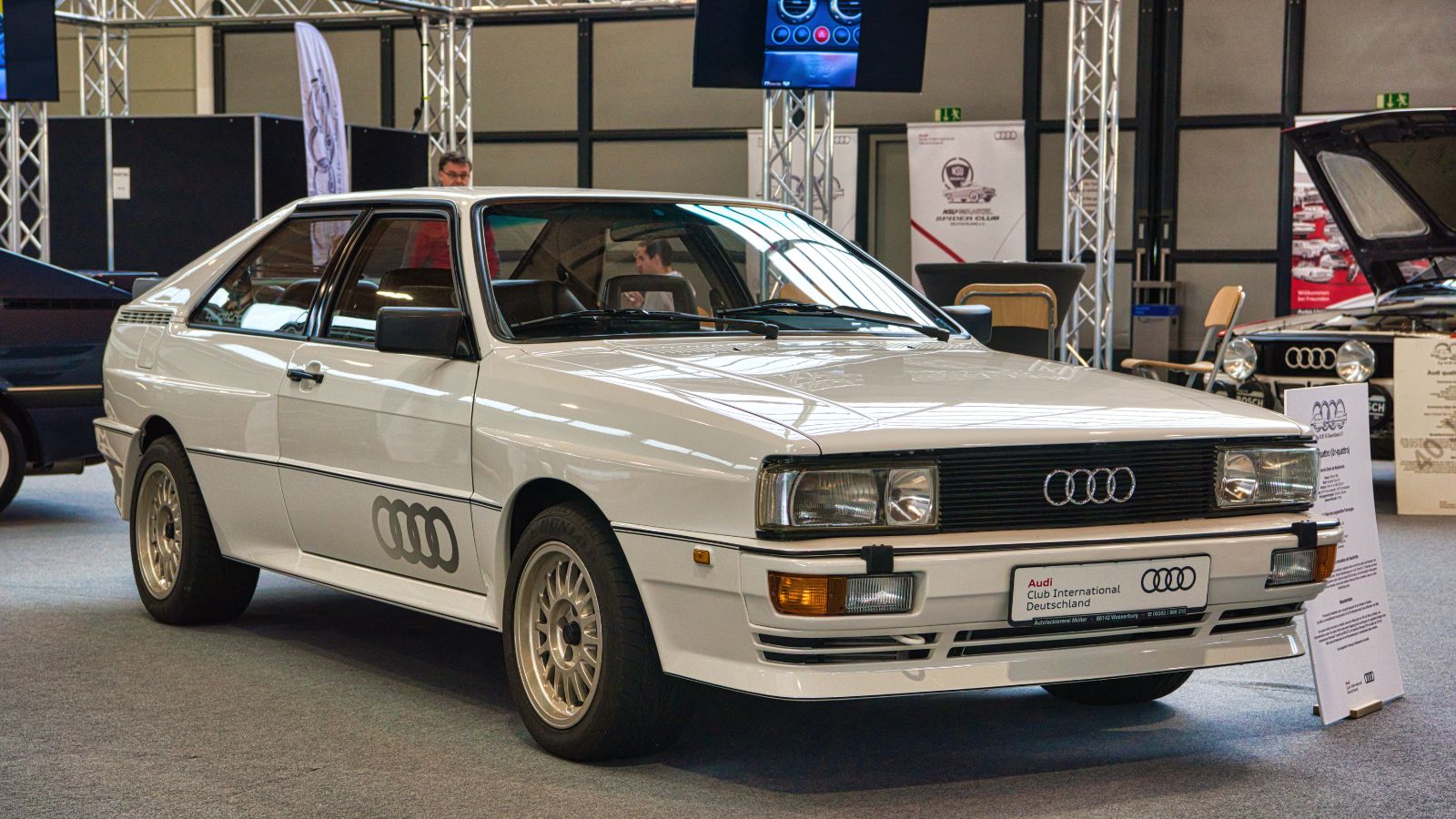
The story of the Audi Quattro begins in the late 1970s, when Audi engineers testing in snowy conditions realized the potential of all wheel drive systems for passenger cars. At the time, the idea of fitting a rally car with permanent all wheel drive was almost heretical. It added weight, complexity, and flew in the face of conventional rear or front wheel drive setups that dominated motorsport. But Audi saw something different, a way to harness grip and power in a way no one had dared before.
Engineering the Revolution
The first Audi Quattro debuted in 1980 as a boxy coupe with flared arches, a turbocharged 2.1 liter inline five cylinder engine, and most importantly, a full time all wheel drive system. It produced around 200 horsepower in road going form, which was more than respectable, but it was the drivetrain that made all the difference. Audi’s system used a manually lockable center differential and Torsen units, allowing for a revolutionary transfer of power to whichever wheel had traction.
The Quattro wasn’t just another sports car. It was a proof of concept that turned into an arms race.
Domination in Group B
Audi entered the World Rally Championship with the Quattro in 1981, instantly shocking the rally world. On loose gravel, snow, and mud, the Quattro demolished the competition. The car made its mark in the legendary Group B era, where few rules and massive horsepower made for some of the wildest racing ever seen.
By 1982, the Quattro was not just competitive, it was dominant. In the hands of legends like Hannu Mikkola, Michele Mouton, and Stig Blomqvist, the car won event after event, ultimately securing Audi the manufacturers’ title in 1982 and the drivers’ title in 1983.
Later evolutions, including the short wheelbase Sport Quattro S1, upped the ante with more than 500 horsepower and increasingly aggressive aero packages. The S1 E2 version was the ultimate evolution, complete with huge wings, side skirts, and brutal acceleration that could outpace a Formula One car to 60 miles per hour on loose surfaces.
Mechanical and Technical Innovation
At the heart of the Audi Quattro was a turbocharged inline five cylinder engine with a distinctive sound and a strong midrange torque curve. Early versions displaced 2.1 liters and produced approximately 200 horsepower, while later homologation versions, like the Sport Quattro, featured a 2.1 liter 20 valve DOHC engine that delivered over 300 horsepower in road trim and upwards of 500 horsepower in full rally spec.
The engine layout was longitudinally mounted in the front, contributing to the Quattro’s unique handling characteristics. Weight distribution was front biased, which led to initial understeer tendencies, but Audi’s engineers balanced the system with innovative suspension tuning and differentials that allowed maximum traction on any surface.
The all wheel drive system was the real breakthrough. Audi’s Quattro system used a central differential with manual locking in early models, evolving into the use of Torsen limited slip differentials in later versions. This allowed real time distribution of torque between front and rear axles, ensuring relentless forward motion even in the most challenging rally conditions.
The Quattro’s dimensions reflected its rally ready focus. It had a length of approximately 4.4 meters, a width of just under 1.8 meters, and a curb weight ranging from 1,300 kilograms in standard trim to under 1,100 kilograms in stripped down competition models. The short wheelbase Sport Quattro variant improved agility and reduced overall weight, crucial for tight, technical rally stages.
Suspension was fully independent, with MacPherson struts in the front and rear. Braking was handled by large disc brakes, and the chassis was reinforced for the rigors of competitive rallying.
Legacy Beyond Rally
Group B was eventually banned in 1986 due to the extreme nature and danger of the competition, but by then the Audi Quattro had already sealed its place in history. It did more than win races, it rewrote the rally rulebook and brought all wheel drive to the performance world. Audi went on to apply this technology across its range, birthing the quattro brand identity that still underpins its models today.
From gravel stages to showroom floors, the Quattro proved that innovation could win championships. It was not the prettiest car, nor the lightest, but it was the smartest. And that made all the difference.
Conclusion: The Icon That Redefined Rally
The Audi Quattro was the spark that lit a revolution. It proved that grip could be as important as power, and that clever engineering could shatter expectations. In an era of loud, flamboyant rally machines, the Quattro stood tall as the thinking man’s weapon. And its legacy still echoes in every all wheel drive performance car that followed.
It wasn’t just a rally car. It was a declaration of what the future could be.