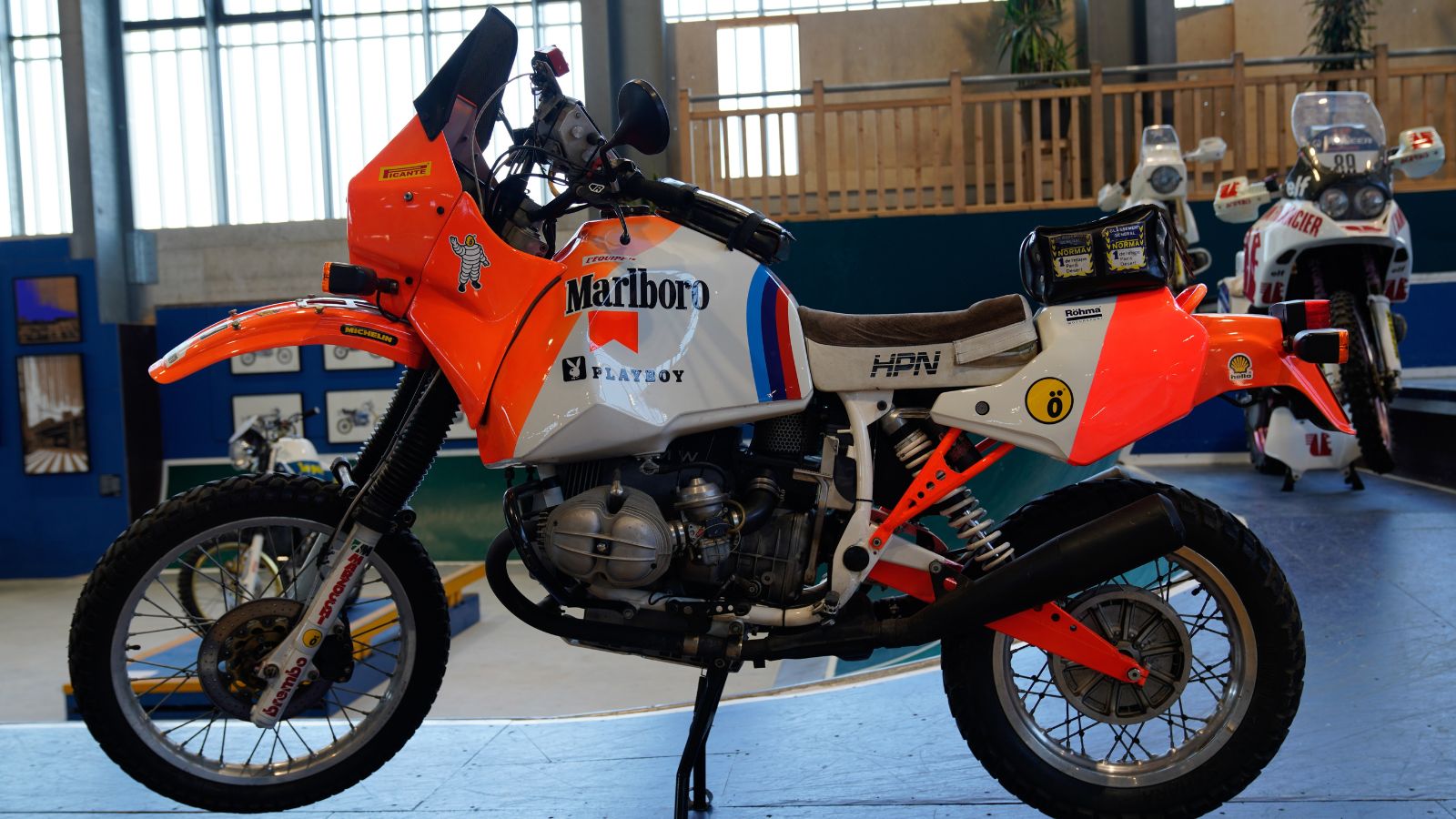
The Paris-Dakar Rally is one of the toughest endurance races on the planet. Extreme terrain, grueling conditions, and relentless mechanical abuse test both riders and machines to their absolute limits. Traditionally, lightweight, high tech, single cylinder off-road bikes have dominated the event. But in the early 1980s, BMW took a radically different approach fielding an air cooled, shaft-driven boxer twin. Against all odds, they not only survived but won. Repeatedly.
The History of the Boxer Twin Engine
BMW’s legendary boxer twin traces its roots back to 1923 with the R32, the first BMW motorcycle. The opposed cylinder layout provided natural primary balance, reducing vibration, while the horizontally opposed cylinders allowed for efficient cooling. Over the decades, BMW refined the design, integrating shaft drive technology and boosting displacement. By the 1970s, the boxer twin had become synonymous with BMW’s road going touring motorcycles but no one imagined it would ever be competitive in the brutal conditions of desert racing.
An Unlikely Dakar Contender
At a time when Paris-Dakar competitors favored single cylinder “thumpers” for their simplicity, light weight, and rugged reliability, BMW’s decision to enter an 800cc air cooled twin raised eyebrows. The R80G/S, based on the company’s road oriented models, featured a shaft drive and a boxer engine—both unusual choices for desert racing. Critics were quick to point out its bulkier design and added complexity compared to the chain driven, lighter competitors.
Yet BMW had a vision. The boxer engine’s lower center of gravity provided exceptional stability in deep sand, and its broad torque curve made power delivery smooth and predictable. These factors would prove crucial in the unforgiving terrain of the Sahara.
The Strength of the Boxer Twin
Despite skepticism, the boxer twin had several characteristics that made it well suited for the grueling Paris-Dakar Rally:
- Low Center of Gravity – The flat twin engine configuration distributed weight low in the frame, aiding stability in soft sand and rough terrain.
- Broad, Usable Powerband – Unlike high strung singles that required constant gear changes, the torquey twin made climbing dunes and navigating technical sections easier.
- Air Cooled Simplicity – No radiators meant fewer components that could fail or become clogged with sand. Without coolant to boil over, the bike remained operational in extreme heat.
- Shaft Drive Durability – While chain maintenance was a daily concern for most competitors, BMW’s shaft drive eliminated the need for frequent adjustments and lubrication.
These advantages, combined with rigorous pre race preparation, turned the BMW R80G/S into a serious contender rather than an underdog.
Winning Against the Odds
BMW’s gamble paid off in spectacular fashion. In 1981, Hubert Auriol piloted the BMW R80G/S to a historic victory in the Paris-Dakar Rally. The win stunned the racing world, proving that a twin cylinder adventure bike could not only survive but excel in the most grueling off road race in the world.
Far from being a one time fluke, BMW doubled down. Auriol’s win was followed by more success, including back to back victories for Gaston Rahier in 1984 and 1985. These wins didn’t just boost BMW’s reputation—they changed the perception of what an off road motorcycle could be.
The Birth of the Adventure Bike
The impact of BMW’s Paris-Dakar success extended far beyond the race itself. The lessons learned in competition directly influenced the development of production motorcycles. The R80G/S, originally a race modified endurance bike, evolved into a commercially available machine that redefined adventure touring.
The DNA of those early Dakar winning motorcycles lives on in today’s GS lineup, the best selling adventure bikes in the world. Modern GS models still carry the boxer twin and shaft drive system, a testament to the durability and versatility of the original design. These bikes, inspired by BMW’s rally heritage, remain the go to choice for riders looking to tackle long distance, multi-terrain adventures.
Why BMW’s Dakar Wins Still Matter
Though modern Dakar Rally bikes have returned to lightweight, single cylinder designs, BMW’s 1980s victories remain legendary. No other manufacturer has managed to make a large displacement, air cooled, twin cylinder motorcycle work at such a high level of competition. The R80G/S didn’t just win races—it rewrote the rulebook for what an adventure bike could be.
BMW’s bold decision to enter the Paris-Dakar Rally with an unconventional design proved that innovation and durability could triumph over conventional wisdom. The air cooled boxer twin, initially dismissed as an uncompetitive choice, became the foundation of an entire motorcycle category—one that continues to thrive today.
A Legacy That Lives On
BMW’s dominance in the early days of the Dakar Rally remains one of the most fascinating stories in motorcycle racing history. Against all odds, an air cooled, shaft driven boxer twin became the machine to beat, proving that outright speed isn’t the only path to victory.
Even as Dakar bikes have evolved, the legacy of BMW’s improbable success endures. Every BMW GS that rolls off the production line today carries the spirit of those early rally winning machines—a reminder that sometimes, the most unconventional choices lead to the most extraordinary achievements.