Most car enthusiasts know that the BMW M3 is a legendary high performance version of the 3 Series, built by BMW’s in house Motorsport division. Since its debut in 1986 with the E30 generation, the M3 has been the benchmark for compact sports sedans and coupes. Known for combining everyday usability with motorsport inspired performance, the M3 has consistently been a favorite among enthusiasts and track day warriors alike.
Across its various iterations, the M3 has evolved with more power, refined technology, and increasingly luxurious interiors. Yet despite all these enhancements, purists often look back at one specific version as the purest and most focused: the E46 M3 CSL.
What Does CSL Mean?
CSL stands for “Coupe Sport Leichtbau,” which translates to Coupe Sport Lightweight. The term has deep roots in BMW’s heritage, originally seen on the legendary 3.0 CSL from the 1970s, a homologation special that dominated touring car racing. The M3 CSL of the early 2000s sought to revive this philosophy, stripping away comfort features and reducing weight in favor of sharper performance and driving purity.
The Engineering Masterpiece
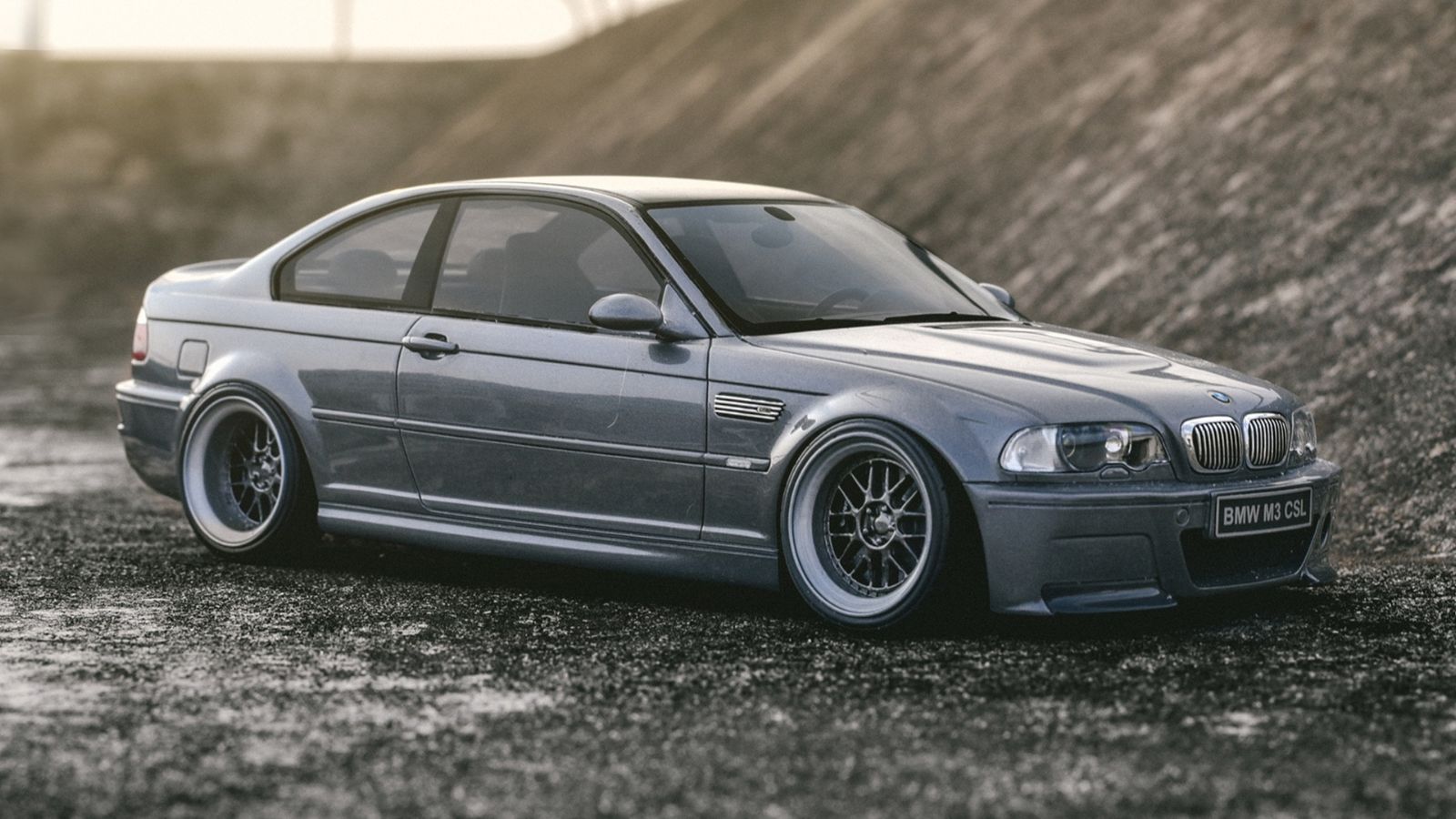
Launched in 2003, the M3 CSL was a limited edition, track focused version of the E46 M3. It featured the same 3.2 liter inline six engine as the standard car, but with key enhancements: a carbon fiber airbox, revised camshafts, and more aggressive engine tuning bumped power to 355 horsepower, up from 333 in the regular M3.
But power alone was not the CSL’s biggest achievement. The car underwent an extensive weight reduction program. It used a carbon fiber roof, thinner glass, a stripped down interior, and lightweight body panels to shed around 240 pounds compared to the standard M3. Even the trunk floor was made from cardboard reinforced plastic. The result was a curb weight of roughly 3,050 pounds.
The carbon roof was not just about aesthetics. It significantly lowered the car’s center of gravity, contributing to sharper handling and improved balance. Doors were aluminum, bumpers were redesigned for lightness, and even sound insulation was reduced.
Transmission and Dynamics
All M3 CSLs came equipped with BMW’s SMG II automated manual gearbox. While controversial at the time for lacking a traditional manual, the SMG offered lightning fast shifts that suited the car’s race bred character. The suspension was retuned, the steering rack quickened, and the car was fitted with Michelin Pilot Sport Cup tires developed specifically for the CSL.
The M3 CSL handled with incredible precision and balance. The steering was alive with feedback, the throttle response razor sharp, and the chassis tuned for maximum communication. It was a car that required commitment and rewarded skilled driving. Its cornering capability, especially on smooth roads or circuits, was nothing short of phenomenal.
The braking system was also upgraded. Larger discs and more aggressive pad compounds gave the car confidence inspiring stopping power. Combined with the stiffer chassis, the CSL delivered a driving experience that was both exhilarating and focused.
The Aural Experience
One of the most defining aspects of the M3 CSL is its sound. Thanks to the carbon fiber intake system and lack of insulation, the CSL produced a spine tingling induction roar that remains one of the most celebrated soundtracks in modern motoring. It is not just noise. It is mechanical music. As the revs climb toward the 8,000 rpm redline, the intake howl becomes a visceral, spine vibrating symphony that is instantly addictive.
The Context of Greatness
When comparing M3 generations, each has its merits. The E30 is the original icon, the E92 had a screaming V8, and the latest G80 M3 packs immense turbocharged power and technology. But none have captured the raw, focused essence of the CSL.
The CSL was not just another trim level. It was a philosophical statement. It reminded the world that weight matters, feedback is priceless, and that a sports car should make your heart race even at modest speeds. It embraced analog character at a time when digital filters were beginning to take over.
BMW only produced around 1,400 units of the M3 CSL, making it a rare and sought after gem. Its exclusivity, coupled with its motorsport pedigree and visceral driving experience, has elevated it to cult status among enthusiasts.
Track and Legacy
Although not homologated for racing like the original 3.0 CSL, the E46 M3 CSL did see some use in motorsport, especially in privateer and club level racing. Its dynamic potential made it a favorite on track days and a benchmark for driving schools. In the years since its release, the CSL has been praised in countless comparison tests as the definitive driver’s M3.
Its influence extended beyond its own production. Future M models, including the M4 GTS and M3 CS, have borrowed from the CSL’s blueprint: lightweight construction, focused engineering, and a back to basics approach to driving enjoyment.
The Ultimate M3
In many ways, the BMW M3 CSL is the ultimate expression of what the M3 badge stands for. It was not the fastest in a straight line, nor the most luxurious. But it was the most connected, the most alive, and the most faithful to the idea of a driver’s car.
As values for the CSL continue to climb, it has become clear that enthusiasts recognize its special place in BMW’s history. It may not have the brute force of newer models, but for those who value purity and precision, the M3 CSL remains the best M3 ever made. It is not just a car. It is a benchmark, a reminder of what true driving joy feels like when all the distractions are stripped away and only the essentials remain.