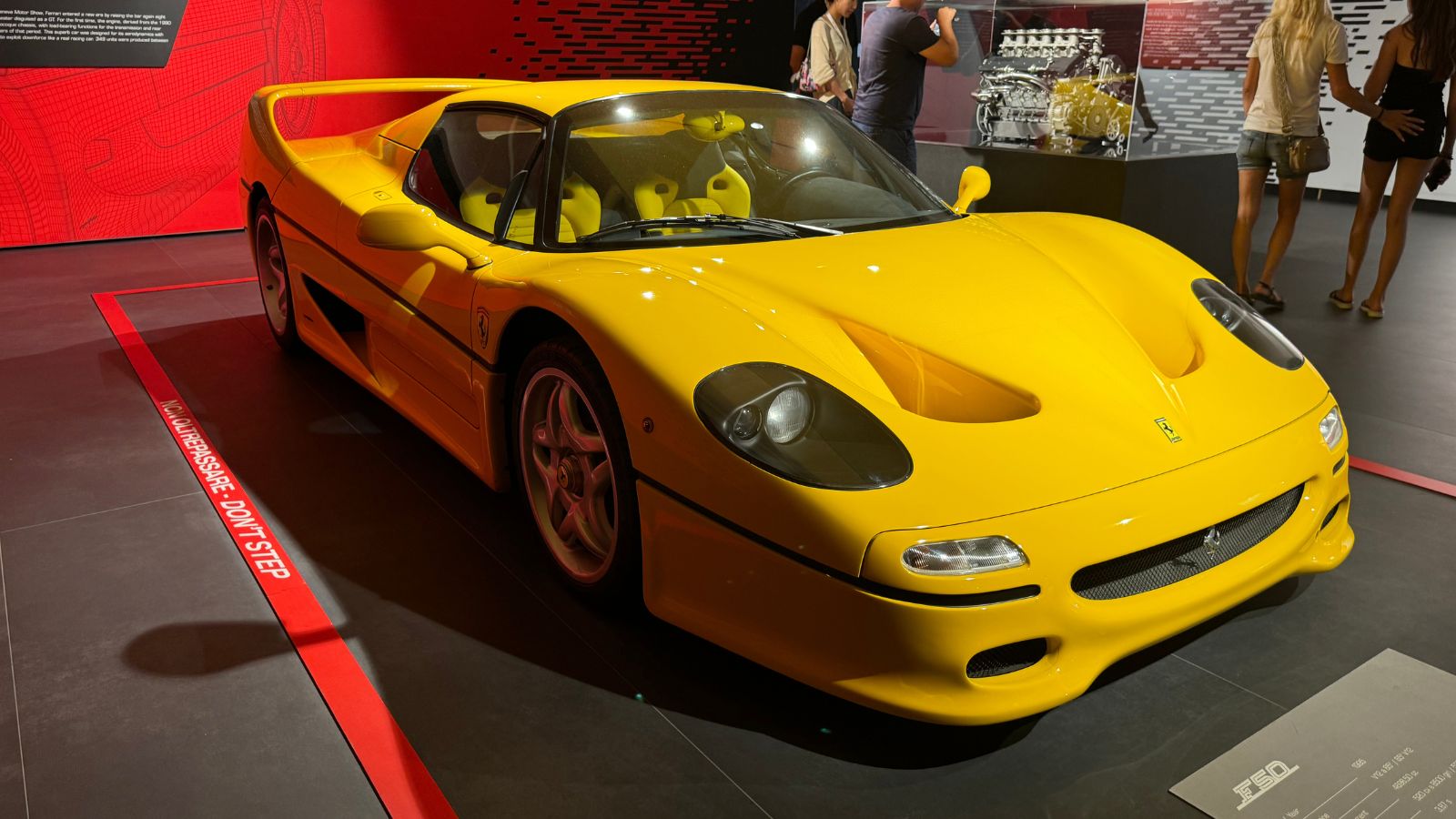
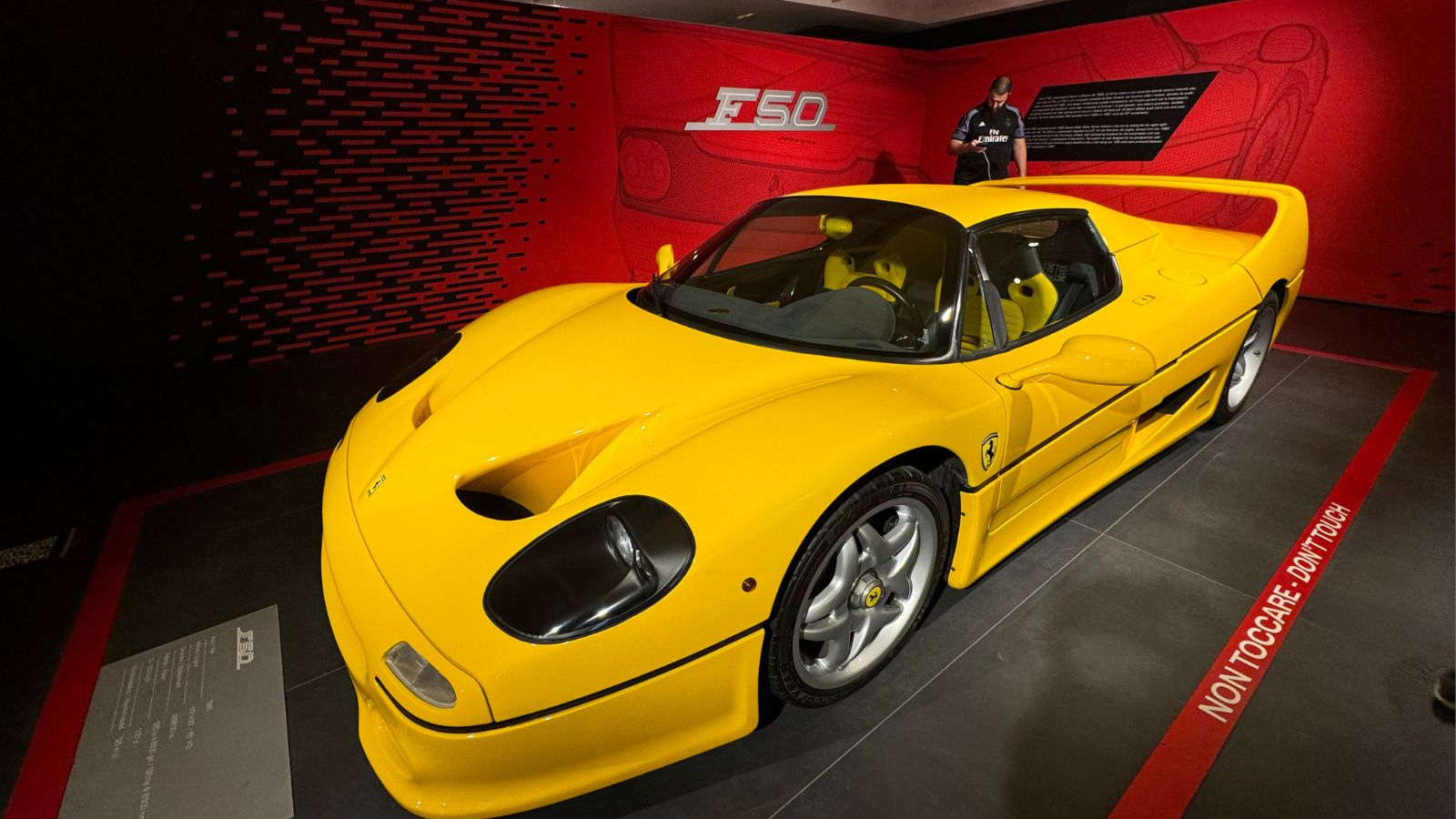
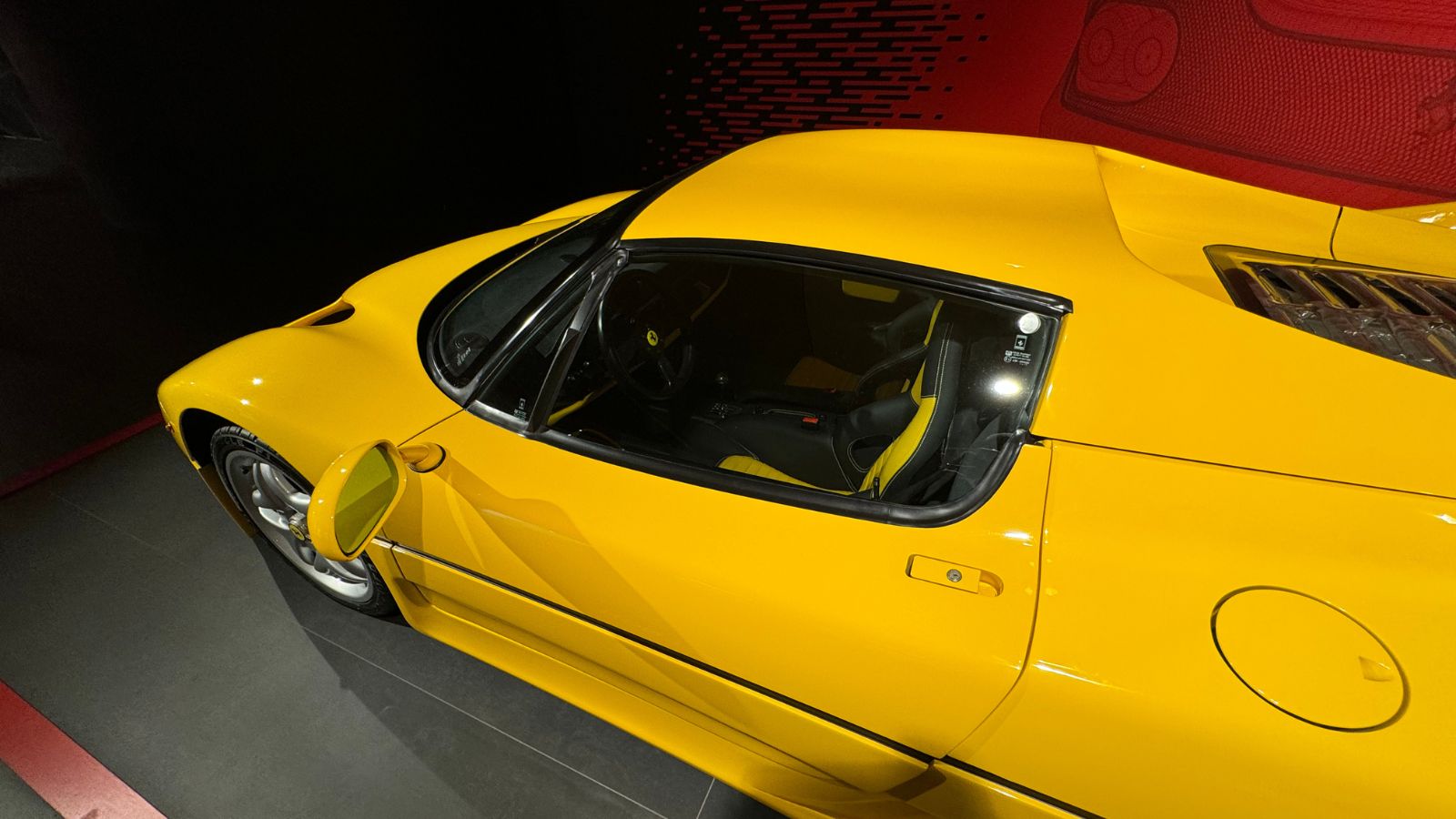
Walking into the Ferrari Museum in Modena is always a special experience, but nothing prepared me for the moment I came face to face with the Ferrari F50 in Giallo Fly yellow. This was no ordinary yellow. Under the carefully designed lights of the display hall, the F50 shimmered like a jewel, its curves alive with tension and purpose. It was the first time I had seen one in person, and the impact was unforgettable.
The sheer presence of the car was electric. This was not just a car you admired; it was a machine that had an aura. The attention to detail in the bodywork, the flawless deep yellow paint, and the functional elements made it feel like a rolling piece of art. The sculpted fenders and dramatic rear wing were not for show they were the result of hours in the wind tunnel and a commitment to race bred engineering.
Filling the Shoes of a Legend
When Ferrari set out to follow the F40, it faced the daunting task of succeeding what many considered the ultimate analog supercar. The F50 was not an evolution of the F40. It was a new philosophy. Where the F40 was raw and aggressive, the F50 was smoother, more organic, and heavily inspired by Ferrari’s Formula One program. It brought genuine race car DNA to the road, more than any Ferrari before it.
The F40 had redefined the boundaries of road car performance, but the F50 took those ideas and added finesse. It was more than just fast—it was refined. Ferrari wanted to build something that not only outperformed its predecessor in certain areas but did so with elegance and mechanical purity. This was the ultimate driver’s car.
A Formula One Heart
The F50’s centerpiece was its naturally aspirated 4.7 liter V12 engine, derived directly from Ferrari’s 1990 Formula One car. This engine revved to 8500 rpm and produced 513 horsepower, sending power through a six speed manual gearbox to the rear wheels. Unlike the F40’s turbocharged V8, the F50’s V12 delivered its power with linear precision and a spine tingling scream.
This engine was mounted as a stressed member of the chassis, another Formula One derived technique, contributing to chassis rigidity. There were no turbos, no power steering, no ABS. It was a true analog experience, built with race car principles and executed for the street.
Even the intake and exhaust notes were carefully tuned. It was a sensory overload, every gear change, every throttle input, and every rev blip was met with immediate mechanical response. The car demanded concentration and rewarded precision.
Carbon, Kevlar and Suspension from the Track
The chassis was a carbon fiber monocoque reinforced with Kevlar, and the car used inboard pushrod suspension with rose joints, mimicking the setup used in open wheel racing. This gave the F50 a tactile feel that was more alive than its contemporaries. Every vibration, every nuance of the road was transmitted through the chassis and steering.
The bodywork was sculpted for aerodynamic efficiency and visual impact. The removable hardtop turned the F50 into a convertible, letting the V12 soundtrack echo freely. Its low stance, rear wing, and integrated intakes gave it a presence that few cars have matched.
The level of engineering precision extended to the suspension geometry, the lightweight materials, and the ergonomics inside the cockpit. It was minimalist but focused, a driver first environment designed to immerse you in the drive.
Performance and Numbers
Weighing just over 3000 pounds, the F50 could sprint from 0 to 60 in 3.8 seconds and reach a top speed of 202 miles per hour. While the F40 was quicker in a straight line, the F50 was the more sophisticated machine. It delivered its performance with more poise, balance, and maturity.
Acceleration was savage yet controlled. The rear drive layout, combined with the balanced weight distribution and precise gearbox, made the F50 feel planted and predictable at speed. Braking performance was equally impressive, aided by large ventilated discs and a carefully engineered chassis.
The F40 vs the F50
The F40 was built from 1987 to 1992, with around 1315 units produced. It was a car designed to dominate the performance conversation of its era. The F50, produced from 1995 to 1997, was far rarer, with only 349 units made. Where the F40 was brash, aggressive, and sometimes brutal, the F50 was refined, technical, and deeply connected to its motorsport roots.
The interiors tell a similar story. The F40 was sparse, with raw panels and little insulation. The F50, while still minimal, featured more refined materials and better ergonomics. The contrast between the two is a reflection of how supercars evolved during that time, from brutalism to sophistication.
Competition Aspirations
Ferrari built a small number of F50 GT versions intended for racing, based on the road car platform but with aerodynamic and performance enhancements. However, due to internal changes and shifting motorsport priorities, the program was shelved before full factory backed competition. Still, the F50 GT stands as proof of the F50’s racing potential.
Many believe that if the program had continued, the F50 GT could have been a dominant force in GT racing. The performance potential was evident, and even in prototype form, it hinted at what might have been one of Ferrari’s great racing machines.
A True Appreciation
Seeing the F50 in Giallo Fly yellow, one of the rarest colors for this model, felt like discovering a secret Ferrari had kept hidden for decades. It was elegant yet aggressive, refined yet raw. The sound, the shape, the aura, it all blended into something that transcended car culture.
The F50 is not just a follow up to the F40. It is a standalone masterpiece that took road car design into race car territory. It demanded more from its driver but gave more in return. And for a brief moment, standing there in Modena, I understood exactly why it was so special.
It was not just the color or the museum lighting that made the F50 unforgettable. It was the purity of purpose behind every component, the absence of compromise, and the soul of a Formula One car made road legal. The F50 may have lived in the shadow of the F40 for years, but in that moment, it stood as the true embodiment of Ferrari’s racing heritage brought to life.