

There are moments in the evolution of transportation that change the game completely. The launch of Slate.Auto might just be one of them. Backed by Jeff Bezos and a team of visionaries, Slate.Auto is set to deliver a groundbreaking new vehicle that could redefine how the world moves. At the heart of this ambitious project is a bold, modular, lowcost electric vehicle designed to be accessible, sustainable, and adaptable to the needs of people everywhere.

Reinventing the Vehicle for the Masses
Unlike traditional vehicles that are built for a one size fits all world, the Slate vehicle is modular by design. This means its components can be easily swapped, upgraded or repurposed. Whether you’re looking for a daily commuter, a last mile delivery vehicle, or even a small family hauler, the same base platform can accommodate multiple configurations. It is car design reimagined, with flexibility and efficiency at its core.
The project aims to disrupt the automotive industry the same way smartphones reshaped communication. Instead of buying a new car every few years, Slate allows you to evolve your vehicle as your life changes. Need more cargo space? Swap out a rear module. Want a more powerful battery for longer trips? Plug in a new pack. It’s simplicity, redefined.
And just as smartphones have become ubiquitous across income levels, so too does Slate aspire to transcend class barriers. It is a car that does not scream status or exclusivity—it simply works. It serves its purpose for everyone, from young urban professionals to working class families and rural small business owners. That kind of mobility, rooted in equity, could be the greatest transformation of all.

A Legacy of Mass Mobilization
Slate.Auto’s vision is not entirely without precedent. It echoes two of the most transformative automotive movements in history: the Ford Model T and the Volkswagen Beetle. The Model T brought the motorcar to the American masses in the early 20th century, revolutionizing personal mobility and laying the foundation for modern industrial production. Decades later, the Volkswagen Beetle became the iconic “people’s car” of Germany, offering millions of Europeans affordable, reliable transportation.
In that same spirit, Slate.Auto seeks to ignite a new wave of mobility—one that is clean, connected, and inclusive. Where the Model T put America on wheels and the Beetle became a symbol of practical freedom, Slate aims to electrify and empower a global generation, giving people not just access to a vehicle, but to opportunity.

Backed by Bezos, Engineered for Everyone
Slate.Auto has the funding and ambition to truly deliver. With Jeff Bezos backing the venture, it’s not just a concept; it’s a mission. Bezos has made it clear that Slate is about more than market share. It’s about mobility for all bridging the gap between sustainability and affordability in a way few have dared to try.
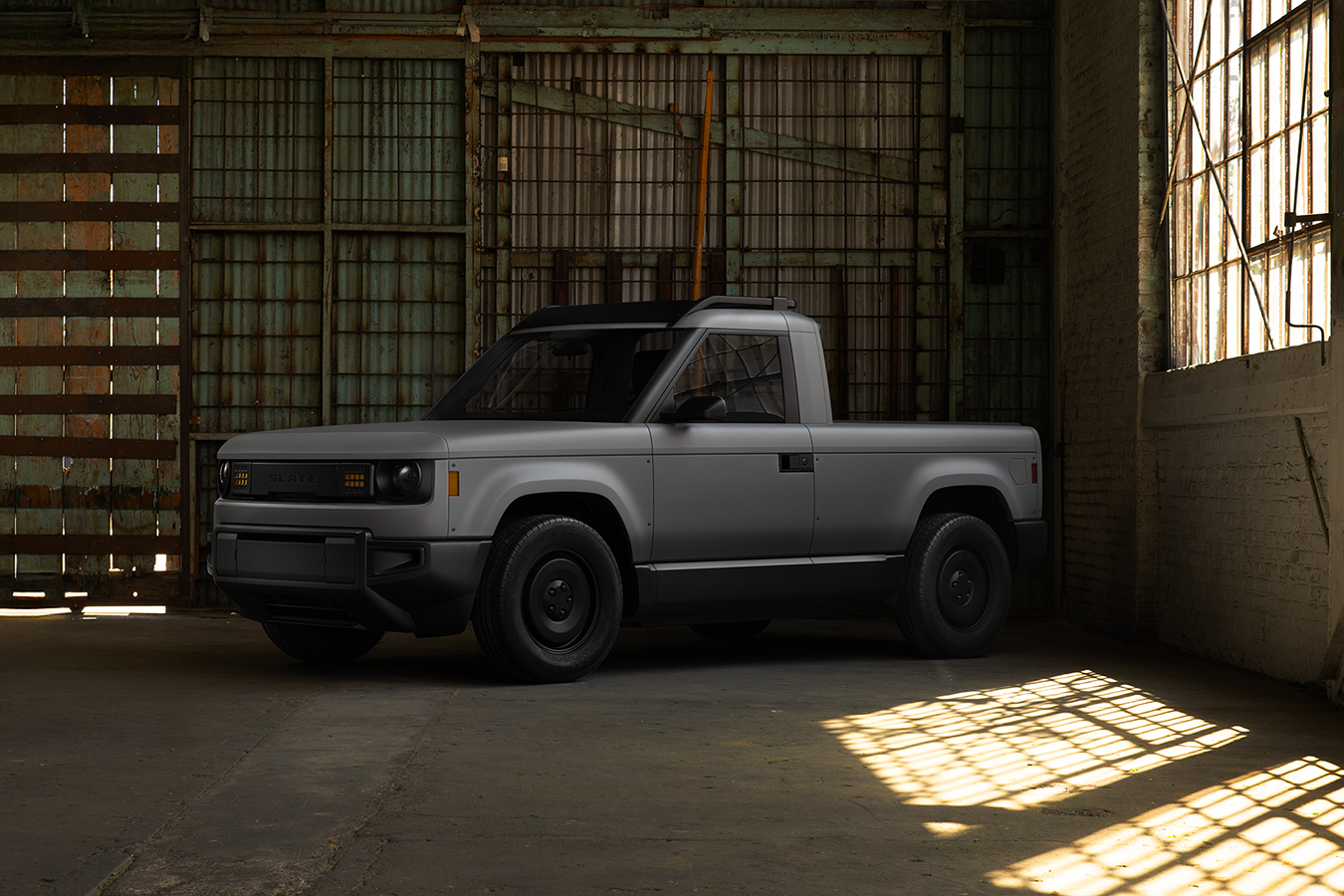
Early prototypes are already turning heads. With clean, minimalist styling and durable construction, the vehicle embodies the principle of function first. And the cost? Slate.Auto is targeting a starting price well below what traditional electric vehicles offer today. That means millions more people around the world could afford a brand new, zero emissions car built for their everyday needs.
And unlike many current EVs, which have become luxury status symbols, Slate is deliberately designed to be classless. Its value lies in its utility, adaptability, and accessibility. By removing the traditional cues of wealth and exclusivity, Slate welcomes everyone behind the wheel. It’s a car that makes no distinction between a tech executive and a delivery driver.
Solving the Real Challenges of Clean Transport
While electric vehicles are cleaner at the tailpipe, the bigger challenge lies upstream in electricity production. Slate.Auto understands this and is working with energy partners to ensure that its vehicles run on power generated from renewable sources wherever possible. Solar integration, smart grid compatibility, and even plans for off grid charging solutions are being built into the ecosystem.
This is critical. As more people adopt EVs, the demand on power grids will rise. By creating a system that encourages clean electricity usage, Slate.Auto is thinking beyond the car. It’s thinking about the whole infrastructure that supports it.
Moreover, Slate is investing in energy education and collaboration with communities. Through pilot programs in underserved areas, they’re testing solar microgrids and portable charging hubs that could redefine how electric transport scales in regions where power infrastructure is limited or unreliable.
A Global Vision of Possibility
The implications of a truly affordable modular EV are enormous. In developing countries, it means rural communities could gain access to reliable transport for the first time. In crowded cities, fleet vehicles could be reconfigured overnight to meet new needs. For families, it’s a promise that owning a car doesn’t have to mean choosing between budget and sustainability.
Slate.Auto is about giving the world options. It’s about saying, yes you can have a car that adapts to your life, not the other way around. It’s about believing that the future of transportation doesn’t have to be exclusive. It can be elegant, efficient, and within reach.
And most importantly, it can be shared. The modularity of Slate also allows for innovative ownership models, community shared vehicles, subscription transport, or job focused adaptations that put tools and independence in the hands of the people.
A Movement, Not Just a Machine
As the first wave of Slate vehicles nears production, the energy around the project is palpable. It’s rare to see something so functional generate so much excitement. But that’s what happens when innovation meets purpose.
Jeff Bezos and his team at Slate.Auto aren’t just building a car. They’re building a platform for change. And if it succeeds, it could reshape how we move, how we think about ownership, and how we tackle one of the most pressing challenges of our time sustainable mobility for all.